








The Short-Term and Long-Term in Gambling
Last update: January 26, 2026
Introduction
Few things in gambling are more misunderstood than the short- and long-term. So in this article we’ll cover:
- What we mean by “long term”.
- How you can be more likely to win in the short term.
- Why “bad in the long term” does not mean “good in the short term”. If a betting system is bad in the long term, it’s bad in the short term as well.
What exactly is the long-term?
"Long-term" isn't a precise number of rounds. A single round is obviously short-term and a billion rounds is obviously long-term, but in between those extremes, we can't say at exactly what number rounds we move from short-term to long-term. You can’t say exactly how many grains of sand you need before it becomes a “pile”, but just because you can’t doesn’t mean there’s no such thing as a pile of sand.
We don’t need to put an exact number on long-term, because trying to do so misses the point. The point is that long-term is a concept, not a precise number. And it’s based on something you already know: the longer you play, the more likely you are to lose.
Behold this graph:
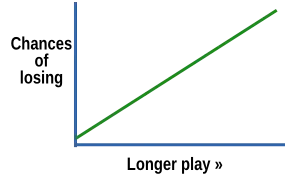
Can you see from the graph when you pass from short-term to long-term? No. The point is just that the longer you play, the more likely you are to lose.
The main reason that people really want to pin down a number on long-term is because they know they’ll lose in the long-term, so they want to limit their play to the short-term. There’s a grain of truth to that (no pun intended) (okay, maybe a little). But a hard and fast number doesn’t exist. The concept is simply that the longer you play, the more likely you are to lose.
Why the long term matters
Longer terms matter for a couple reasons:
- More bets = greater chance of losing
- More bets = greater confidence in the results of a betting system test
Those two things are related. Let’s see an example.
Your friend says he has a winning system for roulette and he wants to show you. He makes his bet, holds his breath while the ball is spinning, and he wins. His evidence that his system works is that he won.
Of course this absurd. He won because he got lucky, not because his method is anything special. You intuitively know that a single spin is not convincing evidence, and would ask him to keep playing, knowing that the longer he plays, the more likely he is to lose. The longer playing time will prove that his "system" doesn't really work.
But how many rounds would he need to play and show a profit before you were convinced? A thousand? Ten thousand? You couldn’t put a precise number on it, and no one could.
But for any number of rounds, either a small number or a large number, we can calculate the chances of being ahead at the end. For example, for American roulette, flat-betting
- After 1 round: 48%
- After 100 rounds: 27%
- After 1000 rounds: 4.5%
Right there we can see that more play = greater chance of loss. That means the more rounds we test for, the more confident we can be about the result. Here’s how our confidence would look for various numbers of rounds:
- 1 round. This is the example I used above. Obviously it's ludicrous to attribute success to a win of a single round.
- 100 rounds. This is still way too short. Our friend has a 27% of being ahead after 100 rounds from pure dumb luck. That's about one in four, like flipping a coin twice and getting heads twice.
- 1000 rounds. At 1000 rounds, we're more likely to see the mathematically predicted result, and we know this is a much better test than 100 rounds. But it's still not enough to have a lot of confidence in the result. No mathematician would consider this long term.
- 10,000 rounds. Here it finally gets interesting. The chances of being ahead here are 1 in 14.7 million. That might be considered long term for some purposes, but not for others. But computers can easily test for many more rounds, so why wouldn’t we?
- 100,000 rounds. This is long term for almost all purposes, for flat-betting American roulette. But for games with a lower house edge, or systems in which the bet amount varies, it wouldn’t be enough rounds for testing.
- 1,000,000 rounds. I would trust a test of 1M rounds way more than a test of 100,000 rounds. But could someone just get lucky and their systems wins the 1 in a million times out of dumb luck? Absolutely.
The takeaways are important enough to repeat:
- More rounds = higher chance of losing
- More rounds = greater confidence in the results of a test
You can win most of your sessions, but it doesn’t really matter
With some betting systems, you’re likely to win your session. The problem is that the losses in the losing sessions are bigger than the wins in the winning sessions. So:
Likely to win your session ≠ winning betting system
Here's an example: There are 38 numbers on a standard roulette wheel. You bet $1 on 35 numbers ($35). You've covered 92% of the numbers, you have a whopping 92% chance of winning. If any of your 35 numbers hits, you'll win $35, plus you get the winning $1 bet back, so you wind up with $36. With a 92% chance of winning $1 on each spin, you stand to win most spins.
But if you keep playing, sometimes none of your 35 numbers will hit. One of the three numbers you didn't bet on will hit instead. When that happens you'll lose all $35 that you wagered. In the long run, this will cancel out all the rounds where you won $1, and then some.
The Martingale system is similar: you're a favorite to win a small amount in any particular short session, but the longer you play, the more likely you are to have a loss, and that loss will be so large it will wipe out all your winnings, and more.
System-believers think they've done something special when they devise some system that wins most sessions. Big deal. It's child's play to come up with a system that wins most sessions, as I did in the roulette example above. What proponents can't do is come up with a system that has an average win across all sessions, because the few losing sessions wipe out all the wins from the winning sessions.
And even for systems which are likely to win in the short term, that term is usually really short. With a $1000 bankroll and $5 bets on the pass in craps, the Martingale has an 82% chance of coming out ahead after an hour, but only 37% after eight hours.
The only real way to try to exploit the likelihood of winning in the short term is to quit as soon as you're ahead, and never play again. After all, the more you play, the more likely you are to lose. And even this method isn't foolproof: Although you're a favorite to win your one session, you could get unlucky and lose that first session anyway.
“Bad in the long term” does not mean “good in the short term”
System-believers argue that while systems can't win in the long term, that's okay because nobody plays into the long term (thousands to millions of rounds). They maintain that their systems will work in the casino because real people play way fewer rounds than in a computer simulation. This reasoning is just 100% wrong. “Bad in the long term” does not mean “good in the short term”. If it's bad in the long term, it's bad in the short term as well.
When we test a betting system, we don’t have to run one test of a billion spins, we can simulate thousands of short-term sessions of, say, 100 rounds each. And all betting systems fail the thousands-of-short-term test as readily as they do the single-long-term test. A system might win most of its short-term sessions, but as we saw before systems that win most sessions are still overall losers, because the losses from the losing sessions outweigh the wins from the winning sessions.
The takeaway is: Long-term losers are also short-term losers.
 Want
to practice a betting system? You can play online right now
at Bovada,
for play money. (Or real money if you insist.)
Want
to practice a betting system? You can play online right now
at Bovada,
for play money. (Or real money if you insist.)
I list Bovada here over other online casinos because:
- You can play without registering. (If you see a registration box, you can close it and continue without registering.)
- You can play the games in your browser without downloading them.
- The games work on both Macs and PC's.
This box is an advertisement, not an endorsement.
Related articles: